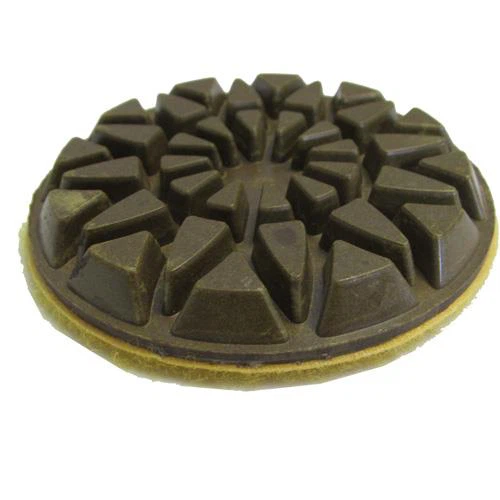
Q: What is concrete polishing pads?
A: Concrete Polishing Pads are special abrasive pads with different roughness and hardness, usually made of materials such as resin and diamond particles. They are installed on the polishing machine and polish the concrete floor step by step as the machine rotates, from coarse grinding to fine grinding, and finally achieve smoothness and gloss on the floor. Concrete polishing pads can be used to polish a variety of materials including granite, engineered stone, marble and concrete. They are typically used in a coarse to fine grit range, with the finer the grit, the better the polish. The standard size is 4 inches (100 mm), but our range includes 3 inches, 5 inches and 7 inches to suit different machines and applications.
Q: What is the main function of concrete polishing pads?
A: Surface polishing: The polishing pad grinds and polishes the concrete surface through abrasive particles (such as diamond, resin, etc.) on its surface to remove the rough layer and defects on the surface, making the concrete surface smooth and delicate.
Glossiness improvement: As the polishing process progresses, the polishing pad can gradually increase the glossiness of the concrete surface to a higher level, giving it a glossy effect similar to marble or granite, thereby improving the overall aesthetics.
Enhanced wear resistance: The surface hardness of polished concrete is increased, and the wear resistance is significantly improved. It can resist wear and scratches in daily use and extend the service life.
Improve the overall quality: In commercial, residential, industrial and other occasions, the application of concrete polishing pads can significantly improve the overall quality of concrete surfaces such as floors and walls, bringing a better experience and feeling to users.
Q: What common faults may concrete polishing pads encounter during use?
A: Wear too fast: The material of the polishing pad is not properly selected, or the particle size used does not match the hardness of the concrete surface, causing the polishing pad to wear quickly in a short period of time. In addition, excessive pressure or long-term continuous use may also accelerate wear.
Poor polishing effect: The particle size of the polishing pad is not properly selected, or the polishing process is not carried out in the correct order and steps, resulting in poor polishing effect. In addition, the surface of the polishing pad is contaminated or blocked, which may also affect the polishing effect.
Uneven edge wear: The polishing pad is not kept flat during installation or use, or the rotation speed of the polishing machine is uneven, resulting in uneven wear on the edge of the polishing pad.
Adhesion and residue problems: Concrete powder, dust, etc. generated during the polishing process may adhere to the surface of the polishing pad, forming residues, affecting the polishing effect.
Q: What are the main materials of concrete polishing pads?
A: The main materials of concrete polishing pads include resin and diamond. Resin polishing pads are relatively soft and are suitable for preliminary polishing and fine grinding stages; while diamond polishing pads are known for their high hardness and wear resistance and are suitable for occasions that require higher polishing effects.
Q: What factors affect the durability of concrete polishing pads?
A: Material and manufacturing process: The material of the polishing pad directly determines its wear resistance, hardness and service life. High-quality materials, such as high-quality resins and diamond particles, can provide better wear resistance and longer service life. The refinement of the manufacturing process will also affect the durability of the polishing pad. Fine manufacturing processes can ensure the uniformity and stability of the polishing pad, thereby improving its overall performance.
Conditions of use: The environment in which the polishing pad is used has an important impact on its durability. For example, the durability of the polishing pad used in a hot, humid or corrosive environment may be greatly affected. Parameters such as pressure, speed and polishing time during the polishing process will also affect the durability of the polishing pad. Excessive pressure or high speed may accelerate the wear of the polishing pad, while too long polishing time may cause the polishing pad to overheat or deteriorate in performance.
Q: How to prevent concrete polishing pads from rusting?
A: Choose high-quality materials: Give priority to polishing pads made of high-quality resins and diamond particles, which are not easy to rust and have excellent wear resistance, hardness and other properties.
Avoid contact of metal parts with moisture: If the polishing pad contains metal parts (such as fixtures, connectors, etc.), ensure that these parts will not be exposed to moisture or corrosive substances for a long time during use. Clean and dry them in time after use to avoid rust caused by humid environment.
Regular cleaning and maintenance: Clean the polishing pad regularly to remove impurities, residues and moisture on the surface, and keep it dry and clean. This not only prevents rust, but also prolongs the service life of the polishing pad and maintains its good polishing effect.
Proper storage: The polishing pad should be stored in a dry, ventilated environment without corrosive substances when not in use. Avoid direct sunlight and humid environment to reduce the risk of rust.
Q: What material is the concrete polishing pads made of?
A: Resin: Resin is a common base material in concrete polishing pads. It has good adhesion and wear resistance, can firmly bond abrasive particles together, and withstand the pressure and friction during polishing. The type and performance of resin will directly affect the hardness, wear resistance and service life of the polishing pad.
Diamond particles: Diamond is one of the most commonly used abrasive particles in concrete polishing pads. It has extremely high hardness and wear resistance, and can effectively remove the rough layer and defects on the concrete surface during polishing to achieve fine polishing. The size and distribution of diamond particles will directly affect the polishing effect and efficiency of the polishing pad.
Binder: The binder is used to firmly bond the abrasive particles to the resin matrix to form a stable polishing pad structure. The type and performance of the binder will also affect the overall performance and durability of the polishing pad.
Q: What fields can concrete polishing pads be applied to?
A: Concrete polishing pads are widely used in commercial buildings, residential buildings, industrial plants, public facilities, outdoor spaces and other occasions. They can improve the beauty and durability of concrete surfaces and meet the needs of floor polishing in different fields.
Q: What factors affect ease of use of concrete polishing pads?
A: The material of the polishing pad directly affects its hardness and wear resistance, and also affects the ease of operation. For example, a polishing pad made of high-quality resin and diamond particles not only has good wear resistance, but is also less likely to be damaged during use, reducing the frequency of replacement, thereby improving the convenience of use. The structural design of the polishing pad is also an important factor affecting ease of use. Reasonable structural design can make the polishing pad easier to install, disassemble and clean, reducing the cumbersome steps in the operation process.
Q: What are the disadvantages of concrete polishing pads?
A: Maintenance and care: Polishing pads will gradually wear out during use and need to be replaced regularly. In addition, in order to maintain the polishing effect, the concrete floor also needs regular maintenance and care. This increases the difficulty and cost of later management.
Scope of application: Although concrete polishing pads are used in many occasions, they are not suitable for all types of floors. For example, in extremely humid or corrosive environments, the performance of the polishing pad may be affected or even damaged.
Q: What is the significance of the particle size of concrete polishing pads?
A: The particle size of concrete polishing pads directly affects the polishing effect. Coarse-grained polishing pads are used for preliminary grinding to remove the rough surface layer; while fine-grained polishing pads are used for fine grinding and polishing to achieve a higher gloss. Choosing the right particle size sequence can ensure the smooth progress of the polishing process and the realization of the final effect.
Q: What issues should be paid attention to during the use of the concrete polishing pads?
A: Regular cleaning: Dust and residue will be generated during the polishing process, and the surface of the polishing pad needs to be cleaned regularly to keep it in good working condition.
Timely replacement: When the polishing pad is severely worn, it should be replaced with a new polishing pad in time to avoid affecting the polishing effect and extend the service life of the machine.
Proper storage: When not in use, the polishing pad should be stored in a dry, ventilated, non-corrosive environment to avoid aging or deformation caused by direct sunlight and humid environment.
Personal protection: Construction workers should wear appropriate personal protective equipment such as protective clothing, masks and gloves to reduce the harm of dust and noise to the body.
Avoid fire sources: Construction materials such as polishing pads should be kept away from fire sources and flammable items to prevent fire accidents.