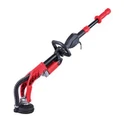
When it comes to refinishing or preparing concrete floors, having the right type of sander is crucial. As a leading supplier of Concrete Floor Sander, I've seen firsthand the diverse needs of contractors, DIY enthusiasts, and industrial users. In this blog post, I'll explore the different types of concrete floor sanders available in the market, their unique features, and the best applications for each.
1. Handheld Concrete Floor Sanders
Handheld concrete floor sanders are the most basic and portable option. They are typically small, lightweight, and easy to maneuver, making them ideal for small - scale projects, spot repairs, or areas that are difficult to reach with larger machines.
These sanders usually come with a single sanding disc or pad, which rotates at a high speed to abrade the concrete surface. Some models are equipped with a dust collection system to minimize airborne dust, which is not only a health hazard but also helps keep the work area clean.
The main advantage of handheld sanders is their affordability and ease of use. They are perfect for DIYers who want to tackle small concrete floor projects around their homes, such as sanding a small patio or a basement floor. However, they have limitations in terms of power and efficiency. They are not suitable for large - scale commercial projects as they can be time - consuming and labor - intensive.
2. Walk - Behind Concrete Floor Sanders
Walk - behind concrete floor sanders are a step up from handheld models. They are larger, more powerful, and designed for medium - to large - scale projects. These sanders are pushed by the operator and usually have multiple sanding discs or pads.
The multiple sanding discs work in tandem to cover a larger area with each pass, significantly increasing the sanding efficiency. Walk - behind sanders are available in different configurations, such as single - head and multi - head models. Single - head walk - behind sanders are more compact and suitable for smaller areas with tight spaces, while multi - head models can cover a much larger area in a shorter time.
One of the key features of walk - behind sanders is their adjustable speed and pressure settings. This allows the operator to customize the sanding process according to the hardness of the concrete and the desired finish. Additionally, many walk - behind sanders come with advanced dust collection systems, which can effectively capture a large portion of the dust generated during sanding.
Walk - behind concrete floor sanders are commonly used in commercial and industrial settings, such as warehouses, factories, and retail stores. They are also popular among professional contractors who need to sand large areas of concrete floors quickly and efficiently.


3. Ride On Concrete Grinder
Ride - on concrete grinders are the heavyweights of the concrete floor sanding world. They are designed for large - scale commercial and industrial projects where speed and efficiency are of the essence. These machines are so large that the operator can ride on them, which not only reduces fatigue but also allows for better control and maneuverability.
Ride - on concrete grinders are equipped with multiple grinding heads, which can be configured with different types of abrasive tools. The grinding heads rotate at high speeds and can remove a significant amount of material from the concrete surface in a short time. They are capable of handling even the toughest concrete floors, including those with thick coatings or heavy stains.
One of the main advantages of ride - on concrete grinders is their high productivity. They can cover a large area in a single pass, making them ideal for projects such as large shopping malls, airports, and industrial complexes. However, they are also more expensive to purchase and maintain compared to handheld and walk - behind sanders.
4. Planetary Concrete Grinder
Planetary concrete grinders are a specialized type of concrete floor sander that offers unique sanding capabilities. The grinding heads on a planetary grinder move in a complex planetary motion, which combines rotation and revolution. This motion ensures a more uniform and consistent sanding pattern, resulting in a high - quality finish.
Planetary concrete grinders are known for their ability to handle a wide range of concrete surfaces, from smooth to rough. They can be used for both light sanding and heavy - duty grinding applications. The planetary motion also allows for better control of the pressure and speed, which is essential for achieving the desired finish.
These grinders are often used in high - end commercial projects, such as luxury hotels, museums, and high - rise office buildings. They are also popular among contractors who need to achieve a flawless finish on decorative concrete floors. However, like ride - on grinders, planetary concrete grinders are relatively expensive and require a certain level of skill to operate.
5. Edger Concrete Floor Sanders
Edger concrete floor sanders are designed specifically for sanding the edges and corners of concrete floors. These areas are often difficult to reach with larger sanders, and edger sanders provide a solution for achieving a uniform finish throughout the entire floor.
Edger sanders are usually handheld or small walk - behind models. They have a narrow profile and are equipped with a single sanding disc or pad that can be positioned close to the edge of the floor. This allows the operator to sand right up to the wall or other obstacles without leaving any unsanded areas.
Edger sanders are an essential tool for any concrete floor sanding project, as they ensure that the entire floor surface is properly prepared and finished. They are commonly used in conjunction with other types of sanders, such as walk - behind or ride - on models, to complete the sanding process.
Choosing the Right Concrete Floor Sander
When choosing a concrete floor sander, several factors need to be considered. The size of the project is one of the most important factors. For small projects, a handheld or edger sander may be sufficient. For medium - to large - scale projects, a walk - behind, ride - on, or planetary sander is recommended.
The hardness of the concrete is another crucial factor. Harder concrete requires a more powerful sander with stronger abrasive tools. The desired finish also plays a role in the selection process. If a smooth, polished finish is required, a sander with finer abrasive grits and more precise control may be needed.
Cost is also a consideration. Handheld sanders are the most affordable option, while ride - on and planetary grinders are the most expensive. However, it's important to remember that the initial cost is not the only factor. You also need to consider the long - term cost of maintenance, replacement parts, and the efficiency of the machine.
As a Concrete Floor Sander supplier, I understand that choosing the right sander can be a challenging task. That's why our team of experts is always ready to assist you. We can provide you with detailed information about each type of sander, help you assess your project requirements, and recommend the most suitable machine for your needs.
If you're interested in purchasing a concrete floor sander or have any questions about our products, please don't hesitate to contact us. We look forward to discussing your project and finding the perfect solution for your concrete floor sanding needs.
References
- Concrete Construction Handbook, various editions
- Industry reports on concrete floor sanding equipment
- Manufacturer's manuals for different types of concrete floor sanders